Dogs were perhaps as important to a child growing up in Alexis as family. But they were not a part of the family in the modern sense. If you had called your dog your “fur baby” or referred to yourself as the “dog mommy” back then, you would have received confused looks. (“Doggy Daddy” did exist, but he was a cartoon character, the canine father of “Augie Doggie.”)
And Grandpa Nelson used to talk about an acquaintance of his who claimed his best hunting dogs as dependents on his income tax, but that was seen as a clever tax dodge, not a familial arrangement.
Rather, humans and dogs inhabited two separate cultures which overlapped in mutually agreeable ways. We liked each other, but we didn’t get carried away about it.
For one thing, dogs lived outside. Most of them, anyway. Aunt Margaret and Uncle David had a highly strung chihuahua (I never knew a chihuahua who wasn’t) named Nicky who stayed in the house most of the time, and in his later years he had a companion who stayed outside, an easy-going basset hound called Homer. And even though Nicky would sometimes bark and growl at us if we crossed one of his invisible boundaries, we mostly got along.
The only true inside dog I knew was my Aunt Doris’s toy dog. We all thought she was crazy for letting that thing in her house. Her family used to tease her that the dog’s feet never touched the ground. She and the dog were inseparable. She even took it visiting with her. It would sometimes sit on her lap as she drove. As much as Mom loved her sister, she was disgusted by having that nasty little rat dog in her house. But of course she couldn’t say anything, but the house always got a thorough cleaning right after Aunt Doris left with her dog. Eventually the dog disappeared, probably because Uncle Martin didn’t like it in his house, either. After that, Aunt Doris seemed to accept the conventional view that dogs live outside.
Dogs were rarely confined. Most were allowed to range freely throughout the countryside, and they kept up an almost-human system of visitation. We would regularly see our neighbor’s dogs coming by to visit with ours, and our dogs would in turn drop by to say hello to the neighbor’s.
Every dog had a more or less regular territory which he patrolled daily. Our woods and fields were crisscrossed with dog-made paths. The paths helped us navigate the otherwise trackless wilderness; they also made it easy to see who had dogs and which ones visited which neighbors.
Only truly vicious dogs and females in heat were penned up. Aggressive dogs were not considered vicious unless they bit the preacher or a law officer. “Oh, don’t mind him,” people would say as you stood frozen in your tracks, held at bay by a snarling, snapping dog. “He’s a good watchdog, ain’t he? I never have to worry when he’s around.” And that was enough to let you know he hadn’t done more than “nipping” a stranger, so if you were a kid you were expected to make friends with the dog and quit whining.
Rusty, my first dog, was “a good watchdog,” but was eventually deemed a truly vicious dog. Mom and Dad couldn’t say anything gruff to me without getting a warning growl from Rusty. When Norman Sisk came to collect the premium on Dad’s life insurance, Rusty charged him, barking and snarling viciously. Norman calmly slid into Dad’s car which was parked in the driveway, until we came out and rescued him.
Rusty also viewed my little brother Gary as a foreign threat, and frequently growled at him. One day he went too far and attacked Gary, and Dad put him down.
The second dog I ever owned – after Rusty, who was too faithful a friend to live – was Roscoe. He was an odd-looking mix of a dog, resembling the pictures of dingoes I later saw. People often called him a “fice,” or “feist,” which the dictionary describes as a “nervous, belligerent mongrel or curr.” According to my Internet sources, a feist dog referred to dogs descended from terriers brought over from Britain. Roscoe was nervous all right, but there was no belligerence in him. And he didn’t look like a terrier in any way. He lived outside his whole life, and in his own way was as loyal as Rusty.
Recently I read an essay written by Richard Rankin, “Last of the Catawba Dogs.” Dr. Rankin describes a breed of wild dogs sometimes called “Carolina Dogs, Indian Dogs, Dixie Dingoes, and American Dingoes.” He says they are “medium-sized, slim, muscular dogs, weighing from thirty-five to sixty pounds. Depending on whom you ask, they resemble a small, light-red German shepherd with a shorter coat or even a light-colored Basenji. But the closest lookalike of all is the Australian Dingo.” The distinguishing characteristics were pointed ears and a fishhook tail, both of which Roscoe had. And his short coat was quite red. A little more research on the Internet revealed that the Southern Dingo was recognized as a legitimate breed by the AKC in about 1980.
The description of the breed seems to fit Roscoe better than the characteristics of the fice. They are intelligent and alert, cautious animals. They tend to shy away from people, but can adopt a family as a substitute for their natural pack. Once bonded to specific people, they remain extremely loyal.
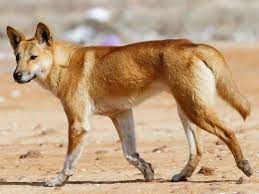
Roscoe apparently felt about most humans about the way we felt about bears. That is, he innately recognized that we were God’s creation and thus due his respect. He wished people no harm, but above all he feared us whenever we intruded into his environment. He rarely barked at us or tried to bite us. He could tolerate our presence, but he preferred to keep his distance.
He seemed to bond to our family, but even then he was wary of us. He was happy enough to see us whenever we stepped outside, especially if we were carrying the “scraps,” anything from the kitchen we didn’t eat, which incidentally was the only food he ever received from us. Store-bought dog food existed but was rarely used in those days. People with lots of hunting dogs, like our neighbor John Abernathy and Grandpa Nelson, supplemented their scraps because their prize hounds needed more to eat than the kitchen produced, but no one fed their dogs a full ration of dog food. “Makes ’em too lazy to hunt,” folks would tell you.
But whether we were carrying scraps or not, Roscoe would run toward us as fast as he could, then stop a few yards away and cower, tail and head lowered in the dog’s universal salute of submission. If we reached out to pet him, he would submit with a blend of pleasure and fear that seemed vaguely obscene. So we rarely petted him. He seemed fine with that arrangement.
Once, in a bold experiment and a desire that Aunt Doris’s rat dog shouldn’t be the only dog admitted into our home, I decided to let Roscoe come inside during a rainstorm that was blowing onto the back porch where Roscoe usually sheltered when it rained. Mom and Dad weren’t home, so I figured it wouldn’t do any harm.
Roscoe was scandalized and refused to have anything at all to do with the scheme. No matter how much I coaxed and tugged, he would not come inside. The back porch was fine, thank you, even if the rain was blowing in. I even picked him up and set him down just over the door sill. The way he scratched and clawed to get away, I was afraid he would go through the screen door. I let him out and never tried to violate his doggy code of honor again.
What Roscoe seemed to appreciate most from us, aside from the daily offering of scraps, was to walk in any direction away from the house. It would be a mistake to assume he came to heel and trotted alongside us. Instead, he ranged all around us, scouting for anything of interest. His scouting was not at all systematic, like a good hunting dog. Instead, he would run ahead a hundred yards, then circle back toward us, wagging his tail expectantly. Then he would run off again, maybe ahead, maybe back where we came from, or maybe off the path entirely, disappearing into the underbrush.
He might return carrying a stick, which he would proudly carry along the trail with us. He did not expect us to take the stick and throw it. In fact, if you did, he would look at you, somewhat disappointed. It was if he couldn’t believe you had just thrown away his best stick. Roscoe, he would tell you if you would only listen, does not fetch sticks. He would look at you sadly for a few moments, then trot off to find another stick in hopes you had learned your lesson.
Or he might lose interest in you entirely and wander off to make his usual rounds through the woods, down to the creek, or off to one of his favorite shady spots.
It was all done without malice. Roscoe didn’t seem to have a mean thought in his whole life. He never growled, seldom even barked. And he was always glad to see anyone, as long as you didn’t crowd him. Even then, he would lie down and take his petting without complaint, escaping as soon as he could.
We boys liked Roscoe just fine, but his lack of social and hunting skills bothered Dad. Once he gave Roscoe away to a co-worker who wouldn’t be embarrassed to own a non-working dog. The man lived about three miles away, on the other side of the large wooded area behind our house. After wrestling him into the car, another human environment Roscoe had little use for, Dad drove Roscoe to the man’s house.
Roscoe got home before Dad did. Dad called the man and they decided to try again the next day, after the man fixed up a place to confine Roscoe until he adjusted to his new owner.
It never happened. Every time the man would open the pen to feed Roscoe, Roscoe would dash out and make a beeline for our house. When the man managed to keep him in the pen, Roscoe would somehow escape overnight and be at our house when we got up in the morning. For awhile Dad would corral Roscoe back into the car and take him back. But eventually Dad decided he was more embarrassed by having a dog that wouldn’t stay given away than he was in having a dog without proper skills.
Roscoe lived out the rest of his days as our guest, a slave to no man.
***
We had several other short-time guests who happened to be dogs. Most simply showed up in our yard and stayed for a few days or weeks. Most would then disappear, moving on as their restless spirits urged them. A few enlisted as pets with some other family that had a cast of other pets or a selection of scraps that they rambler found more to his liking. For the most part, they simply moved on. We never knew whether they got hit by cars, eaten by wolves, or moved without a forwarding address.
The ones who stayed more than a week or so were assigned names. Depending on what our interests were at the time, the names might be traditional dog names or something more exotic. A stray collie was Lassie, after the TV star, until Dad pointed out that was a girl’s name, then became Laddie. He stayed with us until his life was cut short by his addiction to chasing cars.
Our best-looking transient came just a few weeks after we buried Laddie. He looked to be a mix containing the best features of a border collie and a Labrador retriever. He had a flowing, shiny, jet black coat with a small white blaze on his chest. He was instantly friendly and playful, so we took him in without question. He followed us everywhere and seemed destined to stay with us forever.
We decided such a beautiful dog with such innate loyalty needed a special name. Blackie or Scout wouldn’t do. After digging around in the World Book Encyclopedia, I found that the loyal dog of the Greek hero Odysseus was Argus. So Argus it was.
Argus was indeed a loyal dog. He was also an exceptional hunter with a generous spirit. Unfortunately, his quarry of choice was spotted skunks. We had never known there were skunks in our woods until he showed up, but we worried that Argus would hunt them to extinction. Every day or so, he would trot proudly into our back yard carrying a dead skunk in his mouth, which he would lay at the feet of whoever happened to be handy. Mom was not amused, especially when Argus had not been successful in exterminating the skunk before it deployed its defenses. Fortunately Argus was quite skilled at skunk hunting so he rarely got sprayed.
When it did happen, it seemed to be a near-miss. That is, Argus smelled bad, but not as bad as most people said a skunk-sprayed dog smelled. Dad offered a few home remedies for de-skunkification we could try while he was at work, but we found running inside and closing all the doors and windows was the most effective. With his prize delivered and us locked up inside, Argus disappeared back into the woods to find less particular playmates.
Argus turned out not to be a worthy namesake of Odysseus’s famously loyal dog. After about a month, he disappeared. Maybe he had run out of skunks, or he tired of us running into the house when he was too odoriferous.
One day, my friend Raymond Hyde told me at school that he had a new dog – a beautiful, shiny black dog with a white blaze on its chest. He stayed with Raymond about a month, then disappeared forever. The train ran beside Raymond’s yard, but we didn’t see how a dog could jump a freight car. We never figured out where he went. All we knew was no one around Alexis saw him again.
So our Argus was, in the end, less like his faithful namesake and more like the wandering Odysseus.
***
The most talented dog I knew was also a stray, but not one that ever spent time at my house. He showed up at my friend Bradley Howard’s place one day and decided to put down roots. He was a lean, long-legged collie mix. Bradley named him Elvis.
Besides being a universally friendly dog, Elvis had unusual abilities. For one, he was one of the fastest dogs around. We wondered if there was some greyhound in him, which might have explained his long legs as well as his speed.
But his real talent was playing baseball. He was a crackerjack center fielder.
In those days baseball was a bigger sport than football or basketball by far. Alexis Baptist Church had a diamond across the parking lot from the church, and, coincidentally, across the road from Bradley’s house.
Bradley taught Elvis to fetch a baseball – or rather he discovered that Elvis liked to do it. That was about the extent of most dog training we did. We encouraged some behavior that a dog did naturally, then claimed credit for it. Somehow things escalated from fetching to catching, and a star was born.
Bradley could stand at home plate with Elvis in the outfield, then throw the ball as far and high as he could, mimicking a high fly ball. Elvis would run faster than Willie Mays, track the ball, and catch it in his mouth on the fly. The ball would make a cracking sound when it hit his teeth, so much so that we worried that he’d hurt himself.
But he never did, as far as we could tell. He’d trot the ball into Bradley, return to the outfield, and wait for another toss. Soon Bradley found he could use a bat to launch the balls, with the same result. Elvis was a natural fielder.
We discovered Elvis would field for anyone, not just Bradley. In fact, Bradley claimed Elvis had broken up a few church league games by catching balls that were in play and not giving them back to the fielder. Bradley had to start keeping Elvis occupied at home during games to keep him out of trouble.
Other than baseball, Elvis had another hobby, this one more common among his fellow dogs. He loved to chase cars. When he finally caught one, it knocked his eye out. They took him to the vet, who could not save the eye, but sewed the socket shut. After he recovered, Elvis became Elvis the One-Eyed Dog. He was a funny-looking thing, with a neat scar where his second eye should have been, but it didn’t seem to bother him.
Elvis pretty much gave up chasing cars after that, although he did go back to baseball. He continued his fly-catching with undiminished joy, although he couldn’t go to his left anymore. It’s hard to judge a pop fly when your only eye is on the other side of your head.

 Rabbit Box Blog
Leave a comment