Note: Because this piece is about Dad and Mom before they became parents, I have elected to call them by their first names. Keep in mind that Bobby turned 21 in 1948, while Marie was still a teen-ager.
When Bobby returned home after his service in the Army, he declared that he had spent the last several years doing what other people wanted him to do. The next phase of his life he wanted to dedicate to his needs, or, as he put it, “this is going to be the year of Bobby Lineberger.”
He must have felt he was starting behind his peers. Although he was an Army veteran, he was also younger than most of the veterans flooding the job market. Most of his schoolmates had stayed in school and finished on schedule. He was a dropout because of his family’s situation, and he had to start working again to provide money for the family when he got home. While several of his schoolmates did serve in the military, their service came later. They could use the GI Bill to get college degrees, while Bobby later used his to finish high school. I can remember him studying his last few courses when I was little. He had to drive to Gastonia High School (it may have been Ashley High by then), ten or so miles away.
Two of his schoolmates served during the Korean War and earned college degrees through the GI Bill and in fact were principals when I was in school. Joe Bumgardner was one of my elementary school principals. Nesbitt (Neb) Hollis was my high school principal.
Bobby worked with some of his uncles, helping to build houses. While there weren’t any formal apprenticeships, he learned plumbing and electrical work as well as basic carpentry. He said he liked the work except when bad weather kept him out of work (and out of a paycheck).
He bought his first car, a 1938 Ford Coupe he named “Old George.” It was about 10 years old when he got it, and it had several problems, but it was what he could afford. He drove it until I came along in 1951, when he worried that it wasn’t reliable or even safe. He said the stiff mechanical brakes (as opposed to the more modern hydraulic fluid system) were the deciding factor.
There were other problems besides long stopping distances. Old George had no air conditioning, of course, but there was an air intake that could be opened and closed with a knob on the dashboard. The open vent allowed air to enter the cabin. When closed and in its original condition, the vent sealed tight. But by the time Bobby got the car, this function was just a memory. The vent leaked not only air but rain water, sending a cascade from under the dashboard and flooding the floor. Luckily the car had a dash-mounted throttle in addition to the gas pedal on the floor, so Bobby and Marie (once she entered the picture) would sit with their feet up on the seat. He controlled the car’s speed with the hand throttle.
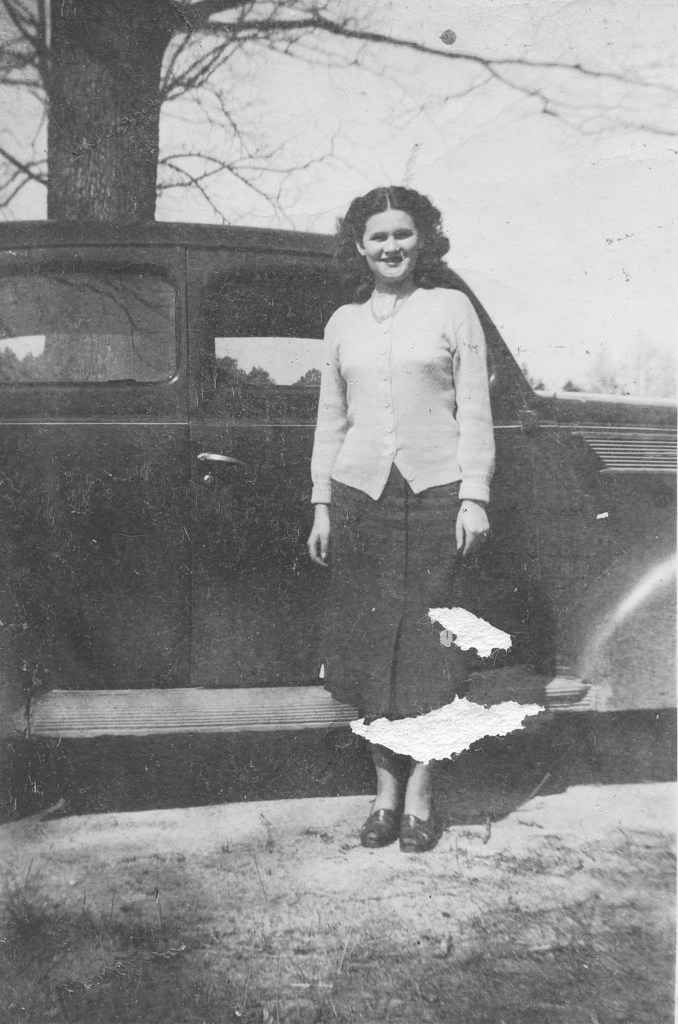
Bobby and his brother Marion, along with another young man and “a Ballard girl” (Mom couldn’t remember their names) started a gospel quartet. They sang at area churches and other gatherings, apparently passing the hat rather than charging a set fee. Bobby told me that one leader said “these young folks are from just across the holler, so let’s take up some money to send them home.”
Bobby joined Mt. Zion Baptist Church, and although he was a member, he didn’t like the church very much. He found the people there split into several feuding cliques. For some reason, maybe because he was a neutral party, he was soon elected church Treasurer. He did not want the office or responsibility, but he served dutifully.
Mt. Zion did not have programs for the young members, while nearby Alexis Baptist did. Bobby and Marion started attending Sunday Evening Training Union there. Alexis Baptist was, of course, Marie’s church. She was aware of the Lineberger brothers, but she doesn’t remember ever talking with them to any great degree.
When she turned 14, Bobby’s sister Margaret went to live with their older sister Blanche, who by this time was married. Margaret returned home after some time, but I’m not sure of the timing. She went to work in a textile mill and gave much of her money to her father, Charlie, to help with family expenses.
Marie started working in the J.P. Stevens textile mill in Stanley (I’m not sure it was a Stevens mill at that time, although that’s how we all knew it) while still in high school. Because of her age, she was allowed to work only until 9 PM, although the shift lasted until 11. She met Margaret, who was also underage, and they became friends. They both rode with the same people, who worked the full shift. So Margaret and Marie spent two hours daily in the waterhouse (restroom, which doubled as the women’s lounge), talking and becoming good friends.
Margaret married David Morris on July 26, 1947, and stopped working in the mill.
Sometime later in the fall of 1948, Margaret thought her brother and her friend might like each other, so she tried to convince Marie to go out with him. Marie refused for a long time, because she already had a boyfriend. But after awhile, she wore down and agreed to go on a date with Bobby.
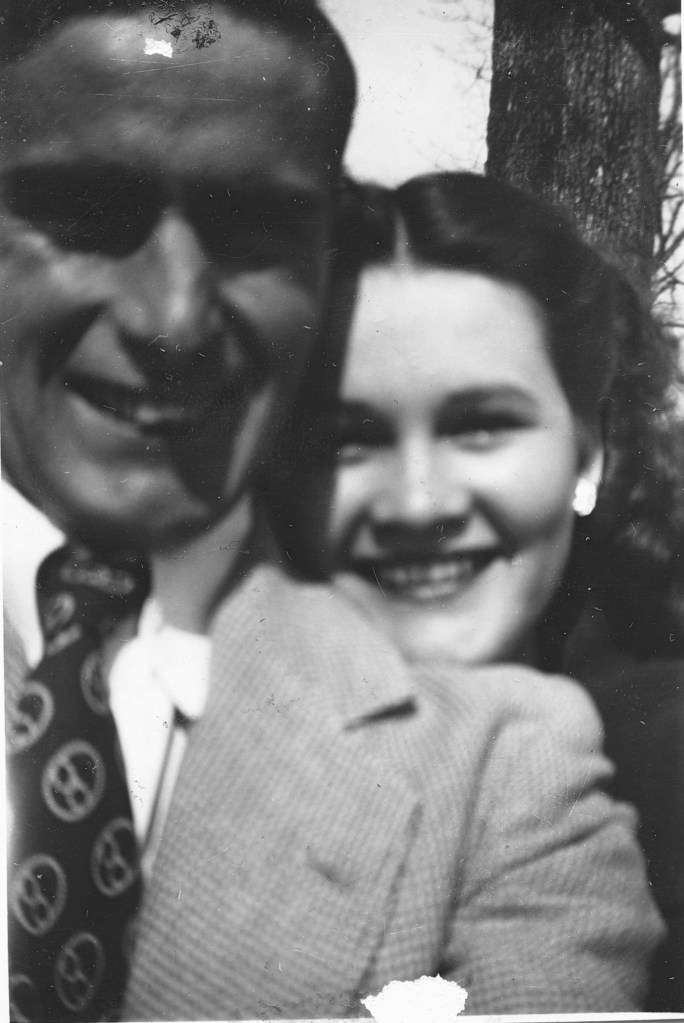
Their first date was a trip to the movies, a double feature. Mom remembers one of the movies as “Ma and Pa Kettle feudin’, fussin’, and fightin’” although I cannot find a movie with anything near that title. If the internet is accurate, the movie was probably “The Egg and I,” which came out in 1947 and featured Ma and Pa Kettle as a subplot. It was still circulating in 1948. No other Ma and Pa Kettle movies were released before 1949.
After the date, Bobby returned home. Uncle Marion later described him as so happy he was singing and whistling. “I just met the girl I’m going to marry,” Bobby told Marion.
Marie and Bobby did not see each other again for awhile. She went to spend two weeks with her Uncle Blaine and his family.
When she came back home she didn’t expect to see Bobby right away. There was no electricity or phone at her house, so of course she didn’t hear from him. It had been raining for several days, and the private road to her house (the old Shelton house I wrote about earlier) was notoriously impassable after heavy rain. One spot in particular, a low area where today Smith-Sproles Road and Nelson Shelton Road separate, turned to something like quicksand in bad weather. A car could quickly sink up to the axles and need a tractor or a mule to pull it out. Nelson sometimes had to park his car out on the main road and hike to it if the weather was bad.
But Marie had not counted on Bobby’s determination (and Army driving experience). After all, it was late in the Year of Bobby Lineberger, and he had a mission to complete.
Bobby pulled Old George into the yard, got out, and knocked on the door. Marie told him she didn’t expect any visitors, and she was not dressed for a date. He said it didn’t matter.
“Let’s go to Margaret’s,” he said. So they did. I don’t know if Margaret knew they were coming.
Margaret opened a can of tomato soup and made some grilled cheese sandwiches.
After they had eaten, as Mom told me, Bobby got her alone and said, “‘I know there’s no moon shining, but pretend there is. Let’s get married.’ I said okay.”
Both families worried that the young couple was rushing things, but they were determined. They married less than two weeks later, at Reverend L.A. McClure’s house near Mt. Zion church, on December 18, 1948. Without thinking about it, they married on Charlie Lineberger’s birthday (although Preacher McClure listed the date as December 19 on the certificate). Mom said they would have changed the date if they had realized it. Bobby’s father was never Mom’s favorite person.
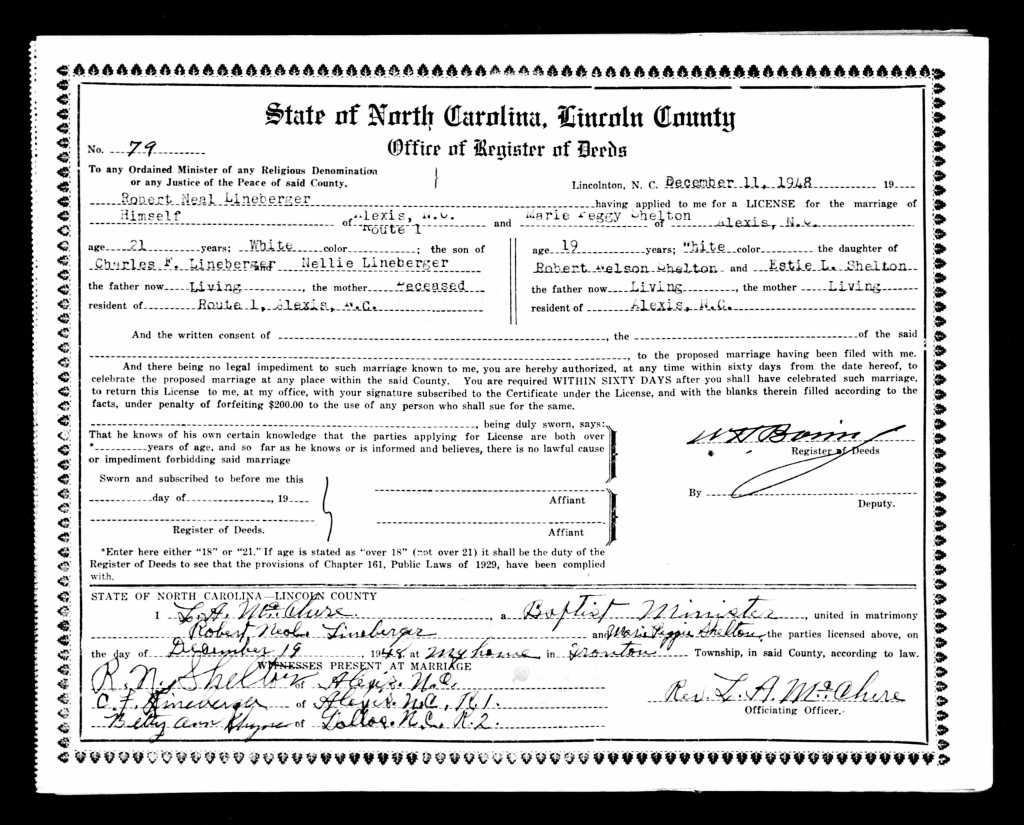
Preacher McClure was apparently something of a marrying preacher, because a lot of couples of that time had their weddings at his house. If memory serves, that includes Margaret and David Morris, as well as Kenneth and Estelle Long, who eventually became my in-laws.
After the ceremony, Marie and Bobby went to a cafe in Mt. Holly and had supper. Mom remembers it included black-eyed peas. They were both tired, because they had packed their belongings and moved them to where they were to live. Mom remembers that Bobby had accidentally packed and moved his suit pants, so he had to wear some other pants for the wedding. He worried about how they looked, but Mom said she couldn’t tell the difference.
Mabel and Graham Abernathy were friends of Bobby’s family, and when he told Graham he was getting married and needed a place to live, Graham offered three rooms in the house with his mother, Karrine Abernathy, who was known as “Granny Abernathy” to most people. The Craigs had been living with her, but they were moving across the road to a house next to a church Preacher Craig had helped organize. The Craigs had obtained two adjacent houses and planned to live in one and use the other for the church. The church still survives today, although the congregation later built a church building and apparently the name has been changed to Mariposa Baptist.
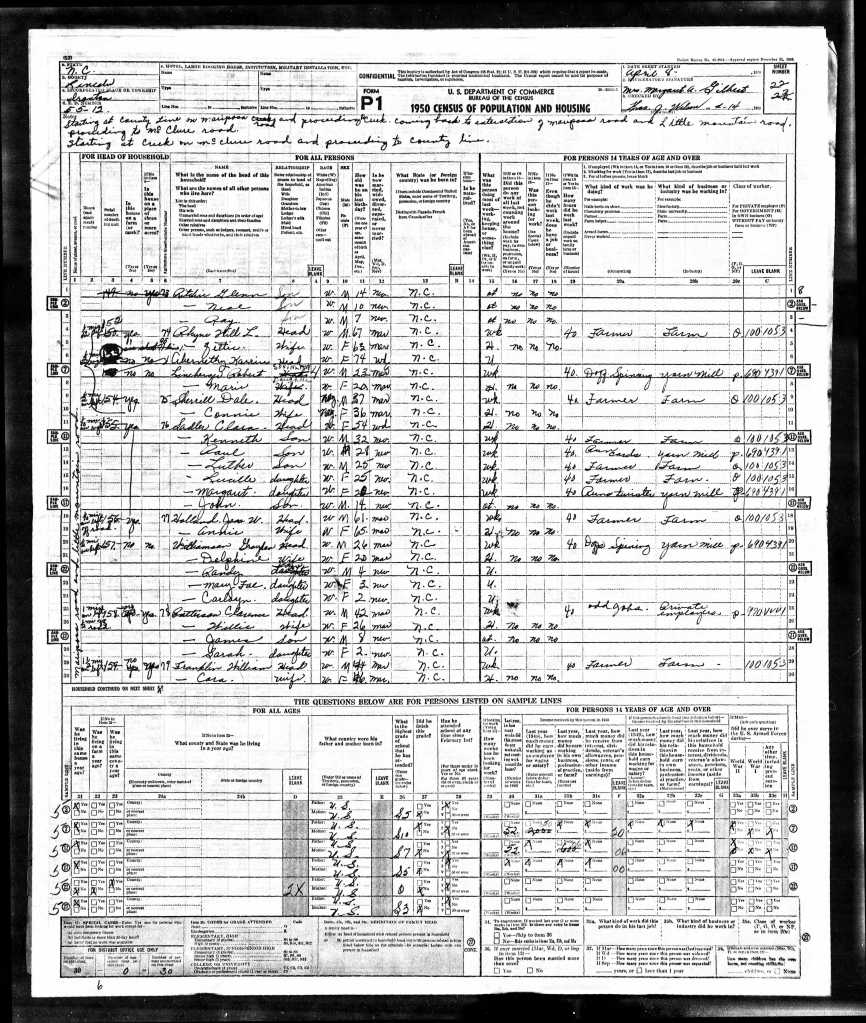
Granny was getting older, and while she could mostly take care of herself, her family didn’t want her living alone. Marie and Bobby stayed with her for several years until they rented the little house in Alexis at the end of Mabry (now Mayberry) Road. I found them listed in the 1950 census, although someone had “corrected” the original entry, assuming that the young couple had to be related to the head of household. Marie is listed as Granny’s daughter, Bobby her son-in-law.

 Rabbit Box Blog
Leave a comment