The house that I knew as Grandpa Nelson Shelton’s house was built by his grandfather Robert Alexander Nance (or Nantz, I’ve seen both spellings used on family documents; Mom says it depended on whether they knew how to write the letter “z.”) in the year Nelson was born, 1905.
At the time the house was built, R.A. Nance owned the property and was living in an older house just up the private dirt road. It was near the spot where the Sproles built their house after they bought the property from Nelson. I never saw Mr. Nance or that old house, but the fallen lumber of their old barn, which Mom says was right next to the house, was still there in my early childhood.
Aunt Sallie Nance and her sister Lillie worked in a textile mill to help raise the money to build the house. Originally the Nances built what we knew as “the old kitchen.” It was a single room with a fireplace in a chimney made of bricks fired on the property. Soon thereafter they built what we knew as the main house, which connected to the old kitchen across a narrow back porch. It had two stories, two rooms downstairs and one room upstairs. The chimney was brick, but I remember the hearth was made of fieldstone, no doubt picked up on the farm. There would have been plenty to choose from. I remember some sections of the road to the house being so full of rocks it was like unprocessed cobblestone paving. We used to pop the tires of our bicycles if we went too fast over the sharp ones.
The rustic hearth had a fairly elegant cherry mantle piece, hand carved by Grandma Estie’s brothers, I remembered. But Mom says my memory was faulty in this regard. The mantle was carved by one of Grandpa Nelson’s uncles, she says. That makes sense, of course, the house being built by his side of the family. Uncle Ray salvaged the mantle and put it in his house after the Shelton house was abandoned.
Mom was in the seventh grade when Nelson bought the house and farm. He borrowed the money from Dolph Landrum in Iron Station. Nelson sold wood from the property to raise money to help pay back the loan. The logging was done over a period of years, and was still going on when I was little. We used to find empty oil cans and other refuse from the logging crews. Mixed among the tree stumps were Coke, Pepsi, Double, and Royal Crown Cola bottles, Spam, chili, and potted meat cans, and even an occasional beer can. I remember seeing trucks loaded with pulpwood leaving the woods.
Originally Nelson and Estie slept downstairs, the children upstairs. At some point Nelson built a partition upstairs to make two rooms. I remember the partition was not frame and sheetrock, but a single layer of wooden planks. The girls got the room with the fireplace, and the boys got the smaller room at the top of the stairs. The stairs themselves were narrow, steep, and dark. Estie avoided going upstairs except at bedtime. She would send one of the children to fetch things, and yell from the bottom of the stairs to wake anyone who was sleeping upstairs.
Mom remembers that there was a rope and pulley system rigged up to bring water from the spring at the bottom of the hill. It was gone before I came along, so I never saw it. The barn that Nelson built during World War II was down a path toward the spring, so the water for the animals must have come from that spring. Hurricane Hugo took down the barn in 1989.
There were at least two springs on the two streams that ran on three sides of the property. Our favorite was the one called The Old Spring (Mom says they also called it The Rock Spring because it bubbled up through a rocky stream bed), upstream from the one below the barn. The Abernathy family, who owned the property on the other side of the creek, called it The Pretty Place. Paul Abernathy built his home near there, and still lives there as of 2023. We used to go to The Old Spring every chance we got. Grandpa Nelson kept an old mason jar hanging on a tree limb nearby, and everyone took turns getting a drink of the spring water, which was cold and delicious even in the hottest summer heat. Because the house didn’t have running water until after it got electricity, they kept a bucket of spring water in the kitchen. Anyone wanting a drink would use the metal dipper hanging on the bucket to help themselves.
Halfway between the barn and the house stood the outhouse. There was never a bathroom in the house. And, yes, there really was an old Sears and Roebuck catalog in the outhouse instead of toilet paper. Actually, because Grandpa Nelson sold Mason Shoes as a sideline, there might have been a Mason catalog as well.
I remember Nelson kept cows for years. Like many of the farmers along Mabry (now Mayberry) Road, he sold milk to a local dairy, one of the few sources of cash in those days. Mom says he did not own all of the cows in his herd. Another man bought some of the cows and let Nelson take care of them in exchange for a share of the profits.
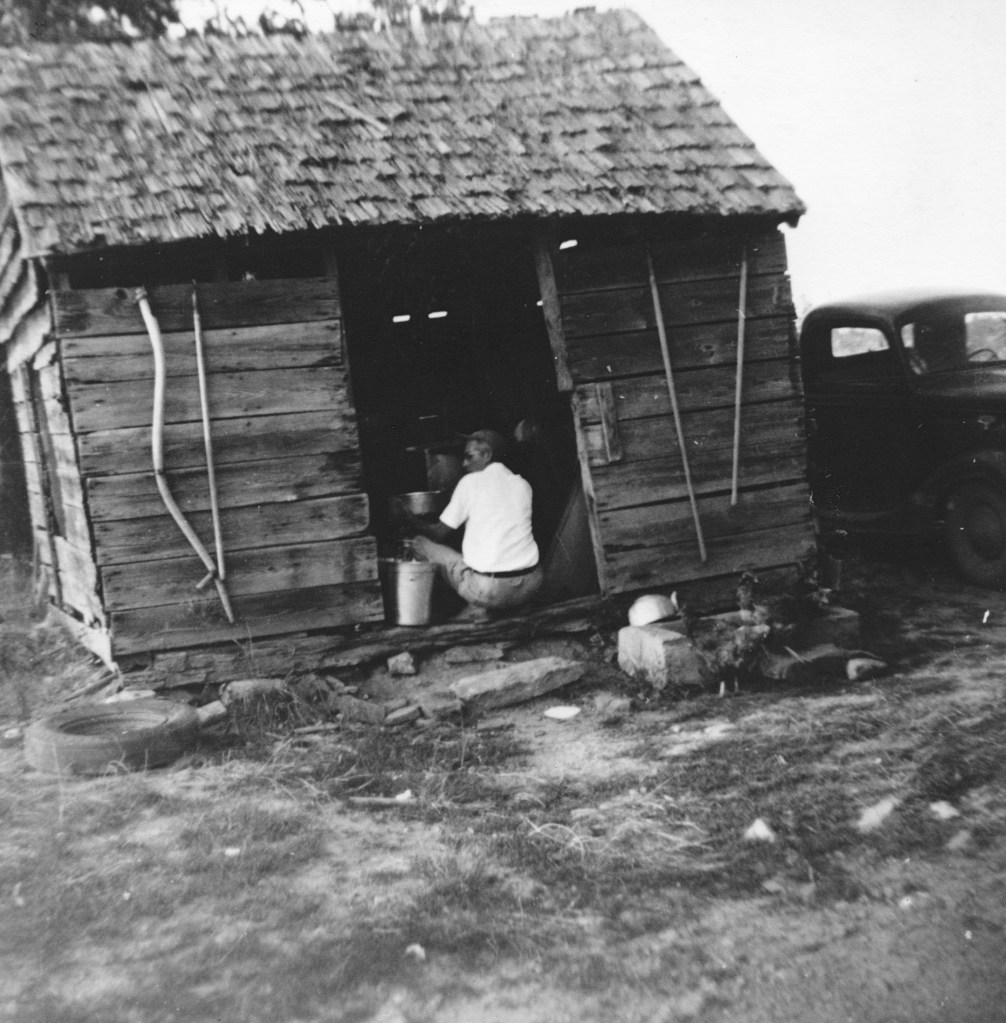
The milk truck would visit the farm frequently (daily? My memory is not clear on that) to pick up the metal cans of milk to take to the dairy for processing. Later, as I recall from visiting the O’Daniel farm down the road from us, the milk was collected in a larger, stationary tank, and the milk truck was replaced with a milk tanker truck, which pumped all the milk into its tank. Nelson was out of the dairy business before the tankers came to be used, and he did not upgrade to mechanical milking machines.
I remember that we all had to watch for bitterweed in the pasture, pull it up, and tell Grandpa Nelson right away. If the cows ate it, their milk would taste bitter and the dairy would reject the entire batch.
In later years Nelson couldn’t make enough money to make the cows worthwhile. But he always kept hogs and chickens, and usually guineas. Guineas were a little wilder than chickens, so they laid their eggs in nests they built in the fields. They were also tougher and harder for predators to take. They also helped protect the chickens by sounding the alarm with their squawking when a hawk came hunting.
Mom said that originally the family ate at a large table in the old kitchen which also held a wood stove, a pie safe, and a cabinet. I remember the room being large and sunny, with windows on the south and west sides. Even though the exterior was board and batten construction, where narrow boards are used to cover the seams between the wider boards, Mom says the room was impossible to heat. They added a chimney flue and placed a wood stove in front of the hearth, where they could also build a fire. In winter the children would bring their clothes downstairs in the morning and get dressed between the stove and fireplace. She remembers Jack pestering the girls by peeking around the stove while they were dressing.
The windows were single hung, single pane and did not fit properly. Mom said they had to remove a window to get any ventilation in the summer, because the windows were not built to open.
The two-story main house was built with lapped siding, cypress I think. Even if the house was cheaply built, the siding held up very well. It was still in reasonable shape when Charles and I returned in the 1990s to take pictures of the old place, although Hurricane Hugo had damaged the roof and accelerated the house’s decay. Nelson always said that paint was what made wood to rot, so he never painted or treated the wood. Uncle Leroy used some silver radiator paint to paint a small part of the house when he was in high school, but Nelson “pitched a fit” when he came home from work, and the house remained unpainted for the rest of its life, until it was torn down in October 2023.
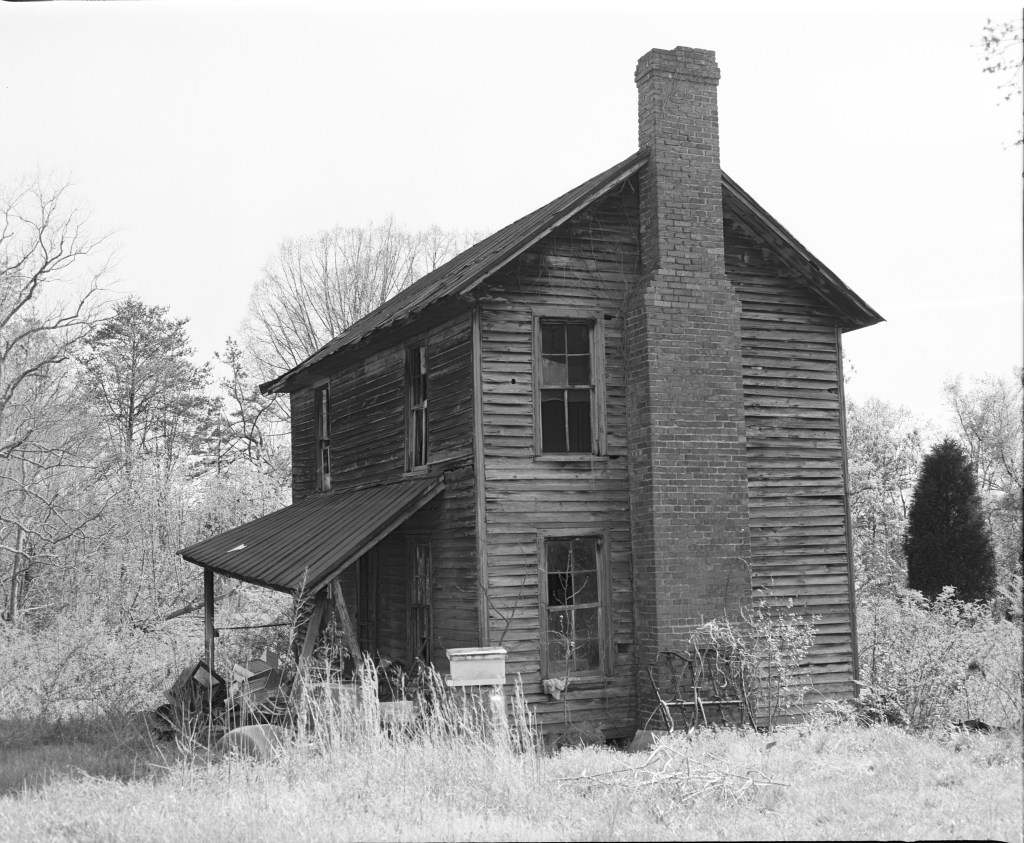
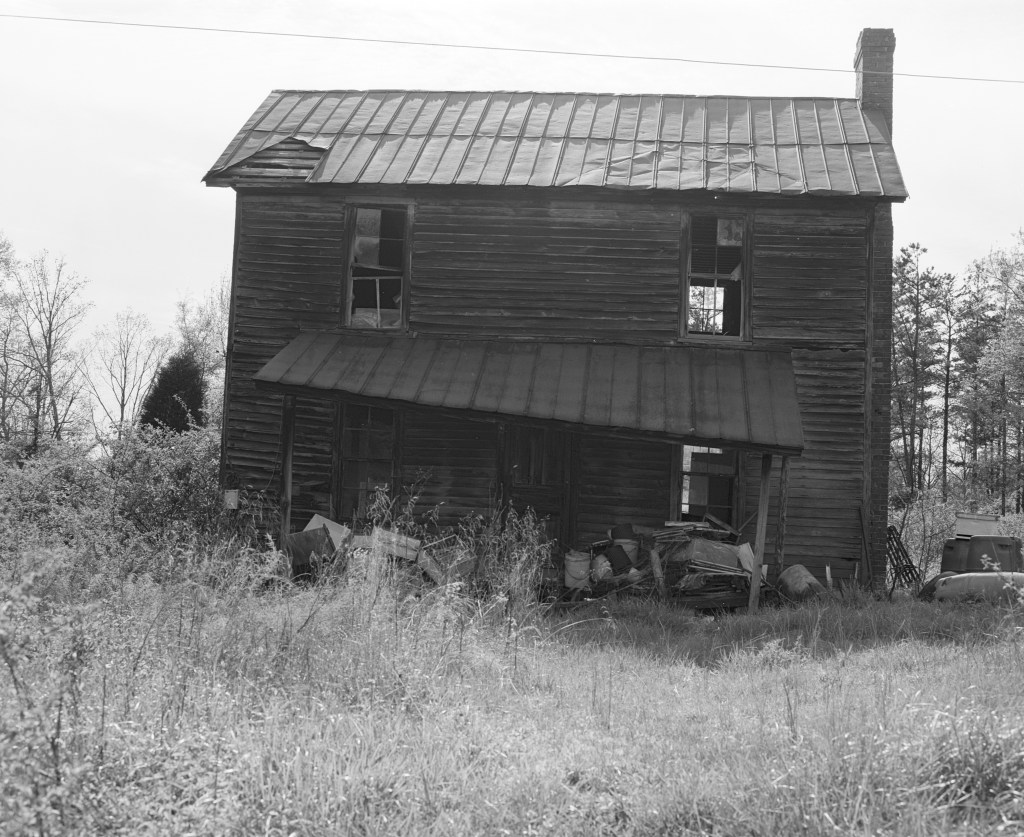
By the time I have any memories of the place, only Uncles Ray, William, and Leroy were living at home. Nelson and Estie slept in the bedroom at the top of the stairs, and the boys had the room with the fireplace. The kitchen was moved into the second room downstairs, with a pie safe in the alcove under the stairs, with a stove and table in the main part of the room. A sink protruded from the alcove into the room. This is where I remember Grandma Estie cooking when I was little, making hoecakes (biscuits much like what people call “cathead biscuits,” baked into an almost solid loaf), spuds (what she always called potatoes), and other delicious food that made her famous throughout the community.
By then the old kitchen was used for storage only. Mom says parts of the floor had rotted, and with all the problems of heating and ventilation, it was no longer habitable. I remember piles of things along a narrow pathway that curved between the door from the back porch to the “back” door. We were always warned not to mess with the piles because there might be a black snake in there. I never saw one, but I took the advice and never went looking.
My cousin Chuck, Harold’s son, and I would sometimes poke around the edges of the piles of stuff, looking for things we could use for our various “projects,” but we pretty much stayed in the aisle during our searches.
Nelson kept an old non-working refrigerator next to the back door, which he used to store seeds for the garden. Like most people in those days, most of his seeds came from drying the remains of last year’s crop. He dried the seeds by putting them inside one of the old car bodies he kept around the farm. He joked that if he had particularly good seeds he could lock the car to keep them safe from thieves.
He didn’t like buying seeds unless he had to. He said the new hybrid seeds were designed to get people trapped into buying seeds every year. He had a point, of course. Hybrid seeds don’t grow true to type, so you could plant a seed from a tomato you liked but if it grew it might produce fruit that wasn’t anything like the parent fruit.
Chuck spent several weeks of every summer vacation staying with our grandparents, and I often spent the night with him after Ray and William had moved out. There were two iron beds in the room, so Leroy got one and Chuck and I shared the other. The only light was a bare bulb in a key-switch fixture hanging from the middle of the ceiling. Chuck and I used to take turns trying to switch off the light and jump under the covers before it got dark. It never worked, but we had fun trying.
When Chuck stayed with Grandma and Grandpa, he didn’t like leaving the house at night, so when nature called he peed onto the porch roof, which was made of galvanized metal. The bedroom had windows facing both the front and back porches, so he alternated to avoid making too much smell that someone might notice. “It washes off in the rain, so it won’t hurt anything,” he always told me.
Electricity came fairly late to the Shelton house, after Mom had married Dad and they had built their house nearby in the early 1950s. Mom remembers that when REMC, the electrical cooperative, started running lines to the area, Arthur Stroupe, who owned the land the lines would have to cross, didn’t want poles in his fields where they would interfere with farming. Finally, Nelson visited Mr. Stroupe and convinced him to give permission.
I don’t remember when the electricity was connected, but I do remember helping Grandpa Nelson carry kerosene lanterns and flashlights to feed the animals after dark because there was no electricity outside the house. Those old lights weren’t anywhere near as bright as lights we have today, so it was still pretty dark duty. I do remember how proud he was when he got a light hooked up over the barn door. I also remember the family still laughing about one of our relatives (maybe Aunt Sallie Nantz, but Mom doesn’t remember who) putting pans and buckets under every outlet in the house on the day the electricity was to be turned on, so the electricity wouldn’t run all over the floor.
The telephone came even later, so much so that I remember it. When our house was built just through the woods from the Sheltons, Southern Bell had not run lines to that part of the county yet, so we could not get service. Dad placed our order as soon as it became available. The only plan we could get was an 8-party line, meaning that essentially we shared extensions with as many as seven other households. All phone sets belonged to the phone company, and almost all were a standard black desk model. The ringer was a mechanical bell, and they were all identical in sound. Each home had a unique number and was assigned a specific ring, a mix of short and long, because all phones rang for any incoming call. I think our ring was three short. Anyone who picked up during any call could hear the conversation, so there was no such thing as privacy. You also couldn’t make or receive a call if anyone was on the line. Voicemail did not exist, so if you tried to call when the line was in use, you would get a busy signal, a series of short beeps.
Nelson said he couldn’t afford to pay the extra charge to have the phone line run to his house. Mom and Dad thought it important to be able to talk to Nelson and Estie without having to drive or walk to their house, so Dad paid the charge. (Mom says he paid for Grandpa Charlie’s line at the same time.) I remember that after the lines were strung, a lineman came out with climbing spurs and made the final connections by climbing up the pole and running a wire to the house. There were no bucket trucks in those days. I happened to be at Grandma Estie’s that day, and it was about as exciting as things got in those days. I wanted to be a lineman so I could wear those climbing spurs.
Because Estie was at home alone all day, she found the relatively isolated farm “lonesome.” In my earliest memory, she had a radio playing most of the time. I particularly remember listening to “The Lone Ranger” with Uncle Leroy. At some point, she convinced Nelson to get a TV. By the time I was in school, they had a television running nonstop in the living room.
Historical note: WBTV went on the air in 1949, but no one I know of had a television that early. WSOC signed on in 1957. Channels 3 and 9 were all we had until the mid-1960s when UHF was added to TV dials and channel 36 (later moved to 18) was available.
The living room, or fire room as Mom says they called it, was the hub of the house. In cold weather there was a fire in the fireplace. Seating was a settee or couch and two platform rockers, one for Nelson and one for Estie. If other seating was needed, straight chairs could be carried in from the kitchen. If more people than that were visiting at once, the men would go outside. They often went outside anyway, because smoking and whittling were not allowed inside.
Nelson was a minimalist in most things, decor included. Estie wanted curtains on the windows; he resisted. At some point she got some translucent, paper-thin curtains for the living room. Even those were too much for Nelson. He complained that they cut off too much light, and he couldn’t see if somebody drove into the yard. So he tied each curtain in a giant knot to hold them out of the way. If Estie untied them, he would fix them back. It turned into a continuing battle.
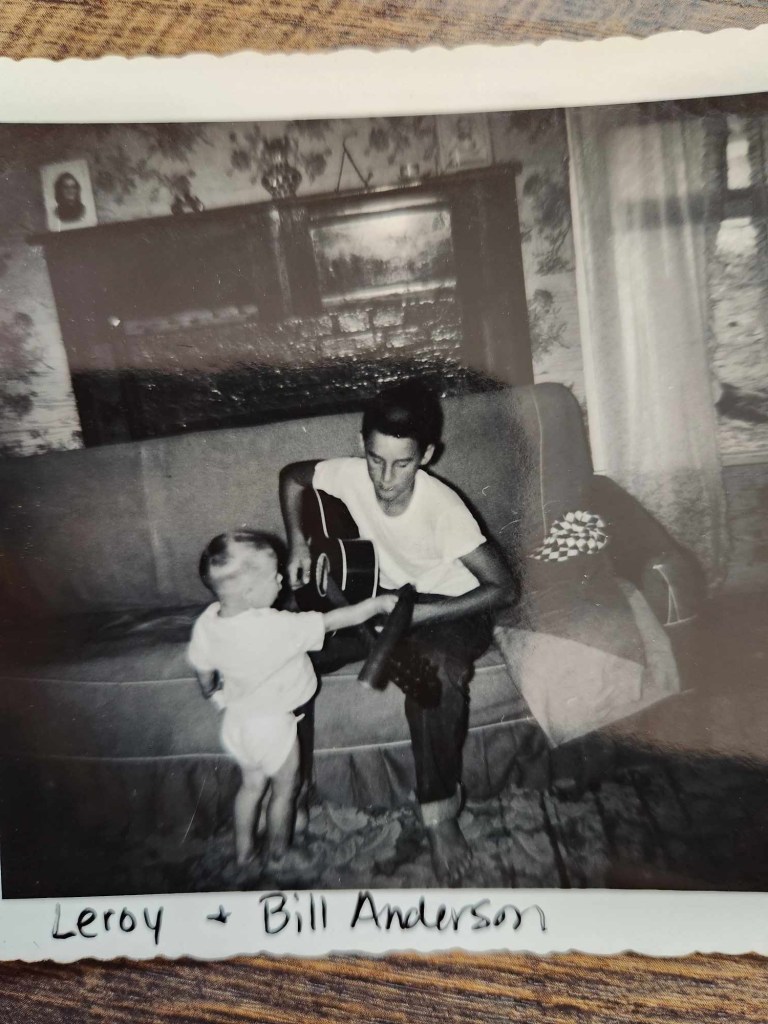
The living room was probably the warmest room in the house, but you couldn’t call it weather (or insect) tight. When the wind whistled on a cold winter’s night, the breeze in the room was noticeable. The fire in the fireplace would dance like an open campfire when the wind blew.
Even though the windows in the main house were operable and fit their frames a little better than those in the old kitchen, they still let in plenty of cold air in the winter. In the summer, the sash could be raised and propped up with a stick. There were no screens. The floor was a single layer of boards that shrank over the years, opening small gaps. If you looked carefully through the cracks, you could see Grandpa’s dogs under the house, where they slept. He typically had between 10 and 20 beagles and other hunting dogs at any given time.
One night, Nelson was sitting in his chair when he had a particularly loud digestive event. From under the house, the dogs began to yelp in panic, and you could hear dog bodies bumping the underside of the house as they fled into the night, crying and yelping the whole way. At least that’s what Estie claimed when she told this story. Nelson would just grin and say nothing, so we took that as confirmation.
I was a young teen-ager when Nelson sold most of the farm to Hubert (or Herbert, Grandpa called him both) Sproles, a former County Agent. He built a modern brick house for his family. As far as I know the Sproles never lived in the old house. Nelson tore down the old kitchen and the back porch and used the lumber to build several outbuildings on his remaining land, where he parked a used mobile home (we always called it The Trailer) he bought from Uncle William. Estie later said that the trailer was the only decent housing she and Nelson ever lived in. I was shocked because I thought the old house was magical. Looking back, I realize the magic was not in the house, but in the people who lived and visited there.


 Rabbit Box Blog
Leave a comment